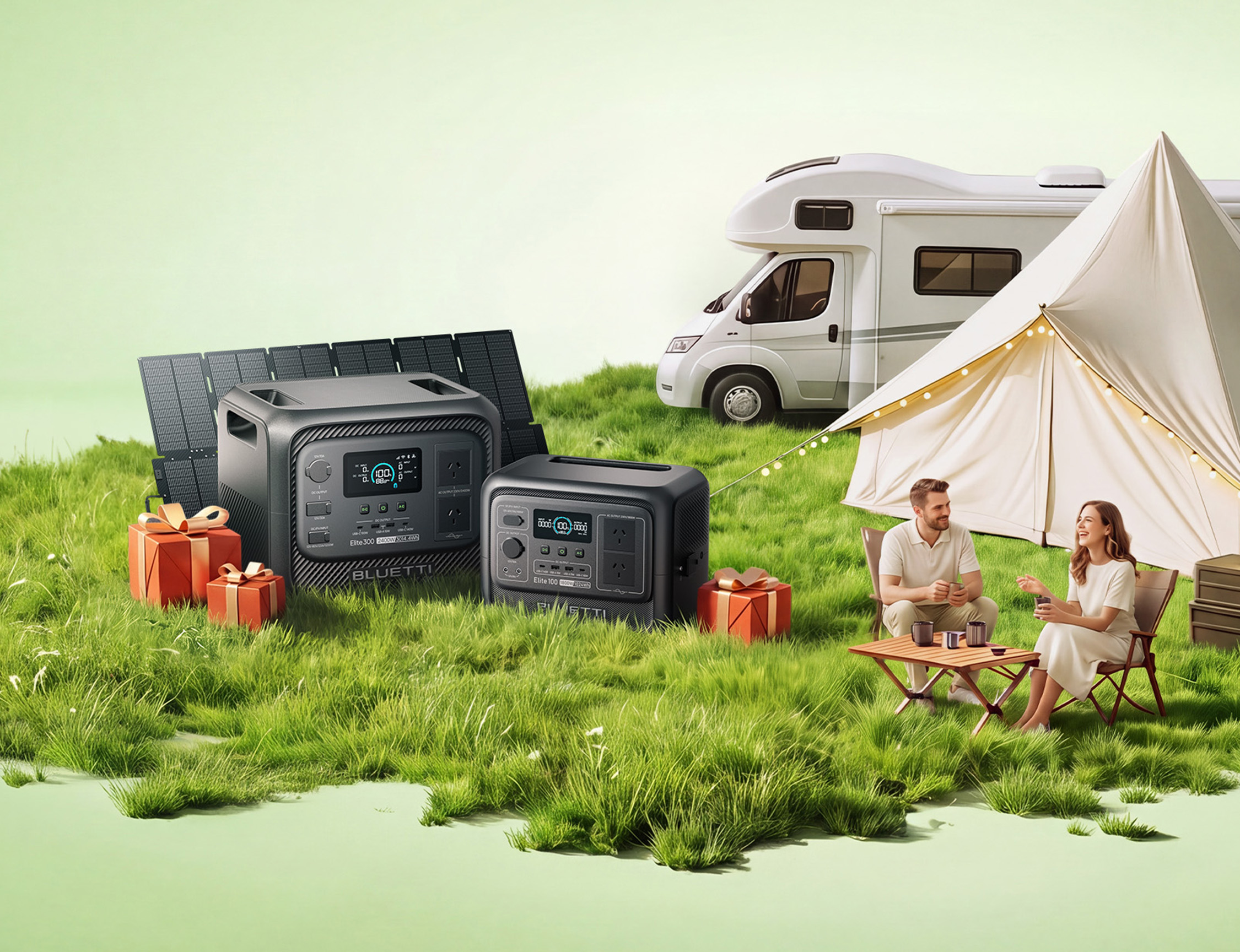

BLUETTI Elite 300 vs. Apex 300: Which Powerhouse is Right for You?

Whether you're prepping for the next sweltering summer storm, planning a lap around the country in a caravan, or just tired of rising energy bills, you've likely looked at the 3 kWh class of portable power stations. In Australia, where bushfires and grid failures are part of life, having serious backup isn't a luxury—it's peace of mind.
Today, we're looking at two of BLUETTI's heavy hitters: the Elite 300 and the Apex 300. While they both sit in that "sweet spot" of capacity, they are designed for very different missions. One is a compact sprinter built for the road; the other is a modular powerhouse designed to grow into a full home energy ecosystem.
Here is how to decide which one deserves a spot in your kit.
At a Glance: Elite 300 vs. Apex 300
Here's a quick look at how the core specs stack up side-by-side.
|
Feature |
Elite 300 |
Apex 300 |
|
Base Capacity |
3,014.4 Wh |
2,764.8 Wh |
|
Continuous AC Output |
2,400 W |
3,840 W |
|
Surge / Lifting Power |
4,800 W |
7,680 W |
|
Weight |
26.3 kg (The lightest 3 kWh) |
38 kg |
|
Scalability |
Standalone unit (Not expandable) |
Super Scalable (Up to 58 kWh with B300K/B500K units) |
|
UPS Switchover Time |
≤10 ms (Pro-grade backup) |
20 ms |
|
Battery Type |
LiFePO₄ |
2nd-gen Automotive-grade LiFePO₄ |
|
Cycle Life |
6,000+ cycles to 80% |
6,000+ cycles |
|
Max AC Input |
2,300 W |
3,450 W |
|
Max Solar Input |
1,200 W |
6,400 W (w/ SolarX 4K accessory) |
|
DC/USB Output Ports |
Built-in (USB-C 140W, 12V/30A RV, etc.) |
Requires optional Hub D1 for DC/USB outputs |
|
App Control |
Wi-Fi & Bluetooth (Remote wake/Timer) |
Wi-Fi & Bluetooth (Weather Alerts/OTA) |
Core Specifications: Capacity and AC Output
Let's start with the raw numbers. While both units operate in the same class, their core power specs reveal two very different design philosophies. It's crucial to understand the two main power ratings:
-
Continuous AC Output: The amount of power a station can supply consistently. This is the number to watch for running your everyday appliances.
-
Lifting Power: A feature that allows the station to handle short-term power surges from high-demand resistive loads (appliances that generate heat using simple elements, like kettles, toasters, or electric blankets) without shutting down.
Here, the difference is significant. The Apex 300 delivers a massive 3,840W of continuous power with a 7,680W lifting capacity. In contrast, the Elite 300 offers a respectable 2,400W continuous output and 4,800W of lifting power.
While the Elite 300 offers slightly more energy storage in its base form, the Apex 300 delivers significantly more continuous power and nearly double the surge capacity. This means the Apex 300 is engineered to run more demanding appliances simultaneously—think power tools, heaters, or kitchen equipment—without breaking a sweat.
Portability and Design: On the Move or Set for Duty?
How you plan to use your power station—whether moving it between the home and the bush or setting it up as a semi-permanent fixture—will heavily influence your choice.
-
Weight & Portability: The Elite 300 lives up to its name, weighing in at just 26.3 kg. Its compact, all-in-one design makes it the clear winner for mobility, perfect for chucking it in the back of the ute or van. The Apex 300 is a heavier-duty unit at 38 kg, better suited for a stationary role in a home, shed, or long-term campsite where it won't be moved frequently.
-
Battery Longevity: Both units are built to last, featuring premium LiFePO₄ battery cells rated for over 6,000 charge cycles before dropping to 80% capacity. Compared to traditional lithium-ion batteries that typically offer 500-1,000 cycles, this LiFePO₄ chemistry guarantees exceptional longevity and safety, making it a far better long-term investment for reliable power. For the Apex 300, this remarkable durability can translate to a service life of up to 17 years.
Ecosystem vs. All-in-One: The Scalability Showdown
This is the most significant difference between the two models. Your decision here depends on whether you need a self-contained unit for today or a foundational piece for a growing energy system tomorrow.

The Elite 300 is a standalone, all-in-one power station. What you buy is what you get—a powerful but non-expandable unit.
The Apex 300, by contrast, is the heart of a powerful ecosystem. It's designed to grow with your needs.
-
It can expand its capacity up to a colossal 33 kWh by adding up to six B500K or B300K expansion batteries in a single unit.
-
For extreme power needs, you can parallel up to three Apex 300 units to achieve a combined output of 11,520 W.
Input and Output: Charging Speed and Connectivity
How you get power in and out of your station is just as important as how much it holds. Here, the differences in design philosophy continue.
Recharging: How Fast Can You Get Power?
Both units offer impressive charging speeds, but cater to different scenarios.
Elite 300 Charging:
-
AC Input: A powerful 2,300 W from a standard wall outlet, capable of reaching 80% charge in 1.6 hours.
-
Solar Input: A strong 1,200 W solar input for efficient off-grid recharging.
-
Combined AC + Solar: By combining the 2,300 W AC input with a solar array, you can achieve the absolute fastest recharge times, perfect for a quick top-up between destinations.


BLUETTI Elite 300 Portable Power Station 3,014Wh, 2,400W
1,200W Max Solar Input
≤10ms UPS Response Time
6,000+ Life Cycles to 80% Capacity
3kWh Power at 2kWh Portability (Just 26.3kg)
8 Versatile Ports for Plug-and-Play Convenience
XT90 12V/30 A RV Port — Ideal for Van Life & DIY Setups
Apex 300 Charging:
-
AC Input: A massive 3,450 W AC input for ultra-fast charging from the grid.
-
Solar Input: A huge 2,400 W of solar input via dual ports, double that of the Elite 300.
-
Advanced Solar: For the ultimate off-grid setup, the solar input can be expanded to an incredible 19.2 kW with the addition of the SolarX 4K accessory.


BLUETTI Apex 300 Versatile Power Station | 3,840W 2,764.8Wh
2,400W Max Solar Input
20ms UPS Response Time
6,000+ Life Cycles to 80% Capacity
Expandable Storage
Ideal for Smart Home Energy Management
Plugging In: Ports and Backup Speed
The Elite 300 is ready to go out of the box, while the Apex 300 offers a more customisable, modular approach.
The Elite 300 features a full suite of 8 built-in ports, including 2 AC outlets, 2 USB-A, 2 USB-C, a cigarette lighter port, and a heavy-duty 12V/30A DC port for RVs.
The Apex 300 focuses its built-in connections on AC power and system expansion. Most DC output ports, including USB-A, USB-C, and the cigarette lighter port, require the separate Hub D1 accessory.
For home backup, the Uninterruptible Power Supply (UPS) switchover time is critical. The Elite 300 boasts a rapid ≤10 ms switchover, while the Apex 300 has a still-excellent 20 ms switchover. What does this mean? The Elite 300's switchover is so fast, it's considered "online" UPS, perfect for sensitive gear like gaming PCs or home servers that can corrupt data with even the slightest interruption. The Apex 300's 20 ms is still incredibly quick and ideal for ensuring essentials like your fridge, lights, and router never skip a beat.
Runtime Realities: How long will they last?
Both units will easily handle essentials like fridges, computers, fans, and lights for hours, making them indispensable during blackouts or on off-grid camping trips.
Runtimes aren't just about the number on the box; efficiency and self-consumption play a role. Using the formulas provided by our engineers, we can estimate how long these units will run your essential gear.
The Formulas:
• Elite 300: Capacity (3,014.4 Wh) × 92% (DoD) × 90% (η) ÷ (Load + 16.5 W)
• Apex 300: Capacity (2,764.8 Wh) × 95% (DoD) × 90% (η) ÷ (Load + 20 W)
|
Appliance |
Load (W) |
Elite 300 Estimated Runtime |
Apex 300 Estimated Runtime |
|
Fridge |
200 W |
~11.5 Hours |
~10.7 Hours |
|
Laptop |
60 W |
~32.6 Hours |
~29.5 Hours |
|
Microwave |
1,000 W |
~2.4 Hours |
~2.3 Hours |
|
LED Light Strip |
20 W |
~68.3 Hours |
~53.1 Hours |
(Note: These are estimates based on standard efficiency; actual results may vary based on temperature and device surge.)
The Elite 300, with its slightly higher base capacity of 3,014.4 Wh, can yield comparable or even longer runtimes for these same low-to-moderate loads. This makes it an incredibly efficient choice for multi-day trips, such as powering a portable esky cooler and camp lights on a long 4WD adventure.
Which One Should You Choose?
Your choice comes down to your primary use case: maximum portability or maximum potential.
Choose the Elite 300 if: your priority is portability, simplicity, and a fast UPS (≤10 ms) in a powerful, self-contained package. It is the ideal choice for caravan touring, 4WD adventures, and backing up sensitive home equipment where you need a no-fuss, ready-for-anything solution.
Choose the Apex 300 if: you need a scalable home or station system with massive output (3,840 W), almost unbelievable solar input potential (up to 19.2 kW with the SolarX 4K accessory), and the ability to expand to an enormous 58 kWh. This is the perfect solution for off-grid properties or remote Aussie homesteads that plan to grow their energy independence over time.
Think of the Elite 300 as a high-performance 4WD ute: fast, efficient, and ready to go right out of the box. The Apex 300 is like a heavy-duty caravan rig: designed to haul enormous loads and expand indefinitely into a massive energy infrastructure.

Shop Products for This Article


You May Also Like