
Should You Buy a Portable Air Conditioner?

Australian summers can be brutally hot, but a portable air conditioner provides quick relief by cooling your space efficiently. The gadgets are, however, pricey to buy and operate. The article assists you in selecting the best one.
How Portable Air Conditioners Work
Portable air conditioners draw in hot room air and pass it over cold evaporator coils, where a refrigerant absorbs the heat. They then return the cooled air to the room while expelling the hot air through an exhaust hose.
They rely on air moisture to produce condensation. Some units collect this in water tanks. Others recycle the moisture using self-evaporating technology. This air cools the condenser before it gets expelled as vapor via the hose.
Single-hose models use room air for cooling, while dual-hose models draw in fresh outdoor air, allowing them to cool faster.
Three Main Types You Can Buy
There are three primary classes of portable cooling units that serve Australians. These are:
-
Single-Hose Models
These ones use one hose to push the air out. This is because they mainly pull the air from your room. They apply some of that air in cooling the condenser. After that, the hot air moves out through the hose. This ends up creating negative pressure in your room. The hot air then moves in from other rooms or outside via the window and door gaps. This means that they work extra hard to cool the rooms.
Single units require less cash compared to dual units. This notwithstanding, the former takes a longer time to cool the room. That's compared to dual units. They operate at maximum capacity (use more energy over time ) the entire day.
-
Dual-Hose Models
Dual-hose units take fresh, cold air from outdoors to cool the condenser. At the same time, the other hose funnels hot air outdoors. As a result, they cool rooms much faster. Further, they conserve energy if you employ them.
Dual-hose models are more expensive upfront but perform better, especially for large rooms, by cooling quickly and efficiently. Most importantly, dual-hose models are ideal for large rooms. Further, dual-hose models cool a room quickly.
-
Self-Evaporating Models
Self-evaporating units handle the cooling process by recycling the condensed moisture. Next is the re-evaporation of the moisture. It's then expelled via the hose together with the hot air. This also means you empty the tanks much less. Indeed, you might not even have to empty them throughout the summer under normal humidity conditions.
This is convenient for busy families. Also, it cools well even during wet weather conditions. These are thus ideal for Queensland's summer. Moreover, the less work of the tank, the less work for you.
Good and Bad Points

What Works Well
- Easy to move between rooms.
- No need for wall holes in rentals.
- Costs less than split systems.
- Cool one room to save money.
- Store easily in winter.
- No tradesperson required to install.
Australian rental residents find these most useful. Specifically, transporting between residences becomes simpler. At the same time, people who own houses employ them for additional cooling. Moreover, dorm residents get cooling without doing any work.
What Doesn't Work Well
- Produce sound levels of 44 to 64 decibels.
- Utilize more power than split systems.
- Heavyweight, meaning it is difficult to shift.
- Window access for the hose.
- Cost more to run than central cooling.
- Occupies floor space within a room.
Noise interferes with both sleeping and TV viewing. Moreover, the sound irritates some users. Consequently, bedrooms require silent ones that are not above 50 decibels. However, for the living rooms, they may easily handle more sound.
Purchase and Operating Costs
The prices of portable air conditioners range from $229 to $1500. Generally, the pricey ones are not necessarily the best in terms of cooling. Contrary to that, the best ones are the medium ones, as tested. This indicates that you do not necessarily have to overspend.
Summer Operating Costs
Running costs depend on power usage—for example, four hours daily increases expenses. Moreover, large devices consume more power.
| Cooling Power | Average Cost | Cost Range |
| 1.2-3 kW | $132 | $66-$161 |
| 3-4 kW | $192 | $173-$230 |
| 4-5 kW | $242 | $210-$317 |
Note: Based on 40 cents per kWh over 90 days
Split systems consume half the power. Still, the installation costs $600 to $1500 extra. That's why portable air conditioners are the better option for rentals. Not to mention that they also work well if you change residences often.
Picking the Right Size
The size of the room will indicate the power that you require. It works like this: you have to measure the length and width of the room. Then, for every square meter, you'll need approximately 0.125-0.15 kW of cooling capacity (or 125-150W per sqm), depending on factors like ceiling height, insulation, sun exposure, and room usage. This equates to roughly 6.7-8 sqm per kW under standard conditions.
Rooms up to 20 sqm typically require 2.5-3 kW. Rooms of 20-35 sqm need 3.5-5 kW. For rooms over 35 sqm, consider 5 kW or more, or multiple units. Always factor in high ceilings (add 10-20% more capacity) or poor insulation.
Crucial Features

Cooling Power and BTU
"BTU" denotes the cooling capacity it has. Normally, cooling large spaces works well through a high BTU. For example, the power of "BTU" that is appropriate for a bedroom is "9,000 BTU." That's roughly a room of 15-25 square meters. At the same time, the "14,000 BTU" corresponds to a "living room." That's a room of around 30-45 square meters. Moreover, extremely large spaces require more BTU.
Weight and Moving
Portable air conditioners weigh between 19.5 and 41 kilograms. The latest ones weigh 23 to 36 kg. This makes handles and wheels very crucial elements. Further, compact units are easier to carry through doors. Further, lightweight units are very convenient when transitioning between different rooms.
Noise Levels
Quiet ones operate at a level of 44-52 decibels during the sleeping mode. Under normal settings, typical ones run at 54-60 decibels. Loud ones operate at a level of 64-74 decibels at the maximum power level. As such, bedrooms require ones that operate below 50 decibels. However, garages are capable of withstanding loud noise. Finally, the issue of noise is more prominent during the nighttime.
Smart Features
The latest units support Wi-Fi for controlling phones. Further, the sleeping modes are capable of changing temperatures during the night. Additional functions involve timers, which initiate cooling before arriving home. Also, others provide heat during winter.
Powering Your Cooling Off-Grid

Portable air conditioners are power guzzlers. As such, living off the grid is not possible without backup batteries. Specifically, camping and rural locations require portable power.
Power blackouts during the summer lead to a hot environment for families. At the same time, storms result in power blackouts. And that's why you need power backup supplies to keep the units running. Moreover, solar power can assist in reducing the power bills.
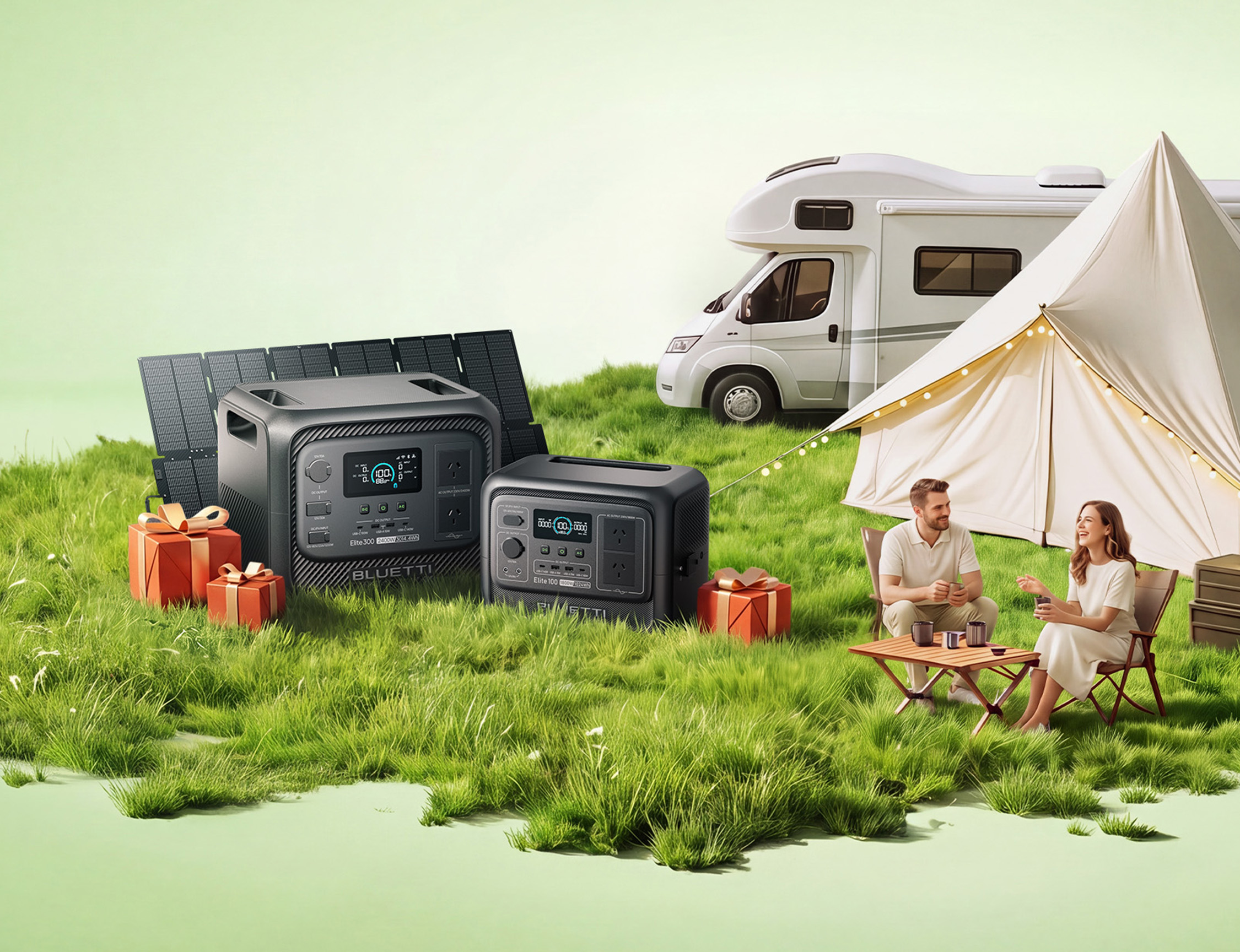
BLUETTI Elite 200 V2
The power of the BLUETTI Elite 200 V2 is 2,600W. Also, a large battery comes with this unit. It provides long hours of operation for your portable air conditioners. Consequently, you are cool all night long.

The solar panel functions well with the device. Specifically, the device charges through the power of the sun. Further, the warranty of 5 years safeguards your funds. Additionally, the device works well in hot Australian climatic conditions.


BLUETTI Elite 200 V2 Portable Power Station | 2,600W, 2,073.6Wh
1,000W Max Solar Input
15ms UPS Response Time
6,000+ Life Cycles to 80% Capacity
MPPT Controller, BMS, and More
Ideal for Home Backup and Outdoor Adventures
BLUETTI Elite 100 V2
The BLUETTI Elite 100 V2 provides a power of 1,800W. At the same time, the battery only weighs 11.5 kg. Consequently, weekend campers find it easy to move it around.

This small device provides power to small- to medium-sized portable air conditioners. As a result, it is sufficient for most camping excursions. Besides that, it is always full of power, considering that it's also charged using solar energy.


BLUETTI Elite 100 V2 Portable Power Station | 1,800W 1,024Wh
1,000W Max Solar Input
10ms UPS Response Time
4,000+ Life Cycles to 80% Capacity
Lightweight and Portable (Only 25 lbs)
Ideal for Camping and Home Backup
Making Your Choice
Is a portable air conditioner worth the investment for you? This depends on your needs.
When They Make Sense
Rental properties require portability in cooling. Specifically, wall units are not permitted by landlords. Furthermore, moving homes requires portability. Moreover, small bedrooms require portability.
Off-grid locations require mobile battery power. Additionally, campers get to experience comfort everywhere. Cooling during renovations also benefits the family. Consequently, consider your living case.
When to Pick Other Options
Owners of houses can consider using split systems. This is because split systems are low-cost to operate. At the same time, split systems operate quietly for good sleep.
Large spaces require more cooling. As a result, central systems are a better option for the house. Split systems consume less power. However, a permanent system increases the value of your home.
Your Questions Answered
- What are the running costs of portable air conditioners?
The running charges vary from $132 to $242 every summer. This is broken down to four hours of operation each day for a period of 90 days. Electricity charges also depend on the energy charges of 40 cents per kilowatt hour. As such, the smaller units will end up saving more funds.
- Can portable air conditioners operate independently?
This is possible because of portable power stations. For instance, a person using the BLUETTI power station gets power without using plugs. At the same time, solar panels work to recharge the power stations during the day. This implies that even the remotest places can remain cool.
- Do they need Windows?
Window access remains crucial for the hose. However, this is not the case for all models, which require sliding doors with correct venting kits. This also explains the importance of good window kits for effective cooling.
- How loud are they?
The level of noise is between 44 and 64 decibels for several options. Generally, the normal operation is nearly 54-60 decibels. Notably, the sleeping modes are quiet, at approximately 44-52 decibels. At the same time, bedrooms require those that are below 50 decibels.

Shop Products for This Article


You May Also Like