
Power Outage Fridge Backup Guide for Australian Homes

- Check first: Determine the running watts, startup demand, and daily energy consumption (in watt-hours, Wh) of your refrigerator.
- Size next: Daily Wh × outage hours ÷ 24, then allow for losses.
- Portable power station: If you have a short power outage, a 1,000Wh to 3,000Wh power station may be the right choice.
- Extended outages: Home battery backup can be appropriate for a few critical loads and extended outages.
- Food safety: Timing advice is included in our separate food safety guide.
Why a Blackout Plan for Your Fridge Matters
One of the most common signs of a power outage fridge problem is a sudden quiet. The hum ceases, and the lights go out. You then wonder about the food inside. Most outages are brief, with some lasting much longer.
In 2026-27, AusNet's Victorian network has annual unplanned-outage reliability targets of 81 minutes per urban customer and 310 minutes per long rural customer. These are annual cumulative outage-duration targets, not actual outage averages or estimates of individual storm-related outages. Your own risk may differ.

This guide is presented in a simple sequence. You determine your fridge's requirements, select backup hours, and then select equipment. When it comes to maintaining a fridge during a power outage, it's typically a question of watts and Wh. Wh is the abbreviation for watt-hours, which is the amount of energy a battery contains.
What Can Keep a Power Outage Fridge Running
The answer is a battery that fits your fridge's requirements. A portable power station is the easiest plug-in solution for most homes. It holds energy and provides 230V AC (alternating current) power via its outlets.
A home battery backup system may be a better option for larger families. These might be appropriate for extended power outages and multiple critical loads. A licensed electrician must install fixed systems, and your state's rules may apply.
The backup power for a fridge begins with 3 numbers. They are running watts, startup demand, and daily energy.
What to Do in the First Minutes of a Blackout
Before purchasing, safeguard what you already have. These steps are free of cost.
- Record the time of the power outage.
- Close fridge and freezer doors, as Ausgrid recommends.
- Check with neighbours to see if they have power, and check to see if your safety switch has tripped.
- Notify your distributor of the outage. In NSW, this is Ausgrid (13 13 88) or Endeavour Energy (131 003).
- The NSW Government advises staying at least 8m away from downed powerlines.
- Turn off ovens and hotplates, and leave 1 light on.

The best way to keep a fridge cold during a power outage is to open it infrequently. If there is a person in the home who is dependent on life support equipment, notify your distributor in advance.
Understanding What Your Fridge Needs
Sizing begins with your own appliance. Fridges use power in 3 different ways. If they are mixed up, you end up with the wrong battery.
Running Watts
Running watts indicate the power consumption of the fridge when the compressor is running. The motor that pumps refrigerant is called the compressor. The figure is located on the nameplate or in the manual. Multiplying the rated current by 230V gives an approximate apparent-power figure in volt-amperes (VA), not necessarily the fridge's actual running watts. Use the manufacturer's input-power specification or a suitable measured power reading for a more reliable estimate.
A plug-in energy meter will provide a more accurate measurement. It is worth the money to get a cheap meter.
Startup Demand
When a compressor starts up, it might require additional power for a brief period. This number is different for different fridges, so there is no universal multiplier for all fridges. Follow the instructions in the manual or contact the manufacturer.
An inverter converts battery electricity to 230V AC. Pure sine wave output (smooth, mains-quality power) is a sensible compatibility criterion. It does not prove a fit. The UPS (uninterruptible power supply) switch time (e.g., 10 ms) is not a guarantee of compatibility.
Daily Energy Use
The number you size from is daily Wh. Annual kWh is shown on the Energy Rating label. Divide it by 365 and multiply by 1,000 to get Wh per day.

The label is a test estimate. Real use can be increased by hot kitchens, door openings, and warm food.
Deciding How Many Backup Hours You Need
Backup hours turn a daily figure into a target. Choose a number that you can justify. Your area and local network are important.
- Short outage: Less than 4 hours, typical in urban areas.
- Overnight: Around 12 hours.
- Multi-day: 24-48 hours or longer, more likely in rural areas.
In 2018, the Australian Energy Regulator reported that customers at network ends may experience slower improvements. If you're in a rural area, plan for longer.
Sizing a Portable Power Station for Your Fridge
Backing up a power-cut fridge setup needs two main checks: power compatibility and backup duration. First, confirm that the power station's continuous AC output can support the refrigerator's running input and any other connected loads. Then check whether its specified startup or surge capability can handle the refrigerator's compressor starting demand. Both requirements must be satisfied. Finally, confirm that the available battery energy can cover your required backup hours.

Use these formulas:
- Rated Wh needed = (kWh per day × 1,000 × backup hours ÷ 24) ÷ efficiency
- Runtime in hours = rated Wh × efficiency ÷ average watts
The efficiency was assumed to be 0.80; it is not a measured value. It is an illustrative allowance for power-station delivery losses and standby consumption, not an additional loss factor for compressor cycling. The fridge's daily energy use already reflects compressor cycling under the conditions represented by that figure. You can use your own metered kWh per day. In a hot room, allow for higher refrigerator energy consumption rather than automatically lowering the assumed inverter-efficiency factor. If you have measured your fridge's actual daily kWh consumption, use that value in preference to the annual Energy Rating label estimate.
| Fridge label | Average W | Startup note | Usable Wh for 12 / 24 / 48 h | Rated Wh at 0.80 for 12 / 24 / 48 h | Minimum output | Tier (12 to 24 h) |
| 318 kWh/yr | 36W | Read manual | 435 / 870 / 1,740 | 545 / 1,090 / 2,180 | Running W covered; startup verified | 1,000Wh to 2,000Wh class |
| 458 kWh/yr | 52W | Read manual | 628 / 1,255 / 2,510 | 785 / 1,570 / 3,140 | Running W covered; startup verified | 2,000Wh class |
| 542 kWh/yr | 62W | Read manual | 743 / 1,485 / 2,970 | 930 / 1,860 / 3,710 | Running W covered; startup verified | 2,000Wh to 3,000Wh class |
These are examples of labels; use your nameplate or metered data. For the two higher-consumption fridge examples, the estimated 48-hour battery requirement exceeds the Elite 300's 3,014.4Wh capacity. With the three standalone power stations compared here, additional charging or a larger-capacity backup system would be needed to cover that duration.
Worked Runtime Examples With 3 BLUETTI Models
Here is how 3 BLUETTI models may perform under the same assumption.
- The BLUETTI Elite 100 V2 has a capacity of 1,024Wh and a pure sine wave power output of 1,800W. It weighs 11.5kg, which means that you can take it to any room. It is suitable for brief power failures for a compatible refrigerator and a few light loads. It has a quick 10ms UPS switchover, though compatibility still depends on your fridge.


BLUETTI Elite 100 V2 Portable Power Station | 1,800W 1,024Wh
1,000W Max Solar Input
10ms UPS Response Time
4,000+ Life Cycles to 80% Capacity
Lightweight and Portable (Only 25 lbs)
Ideal for Camping and Home Backup

- The BLUETTI Elite 200 V2 has a storage capacity of 2,073.6Wh and a pure sine wave power output of 2,600W. Our estimates suggest roughly 27 to 46 hours for the fridges above. Its 3,900W lifting mode suits resistive loads such as kettles, not compressors. Use the 2,600W figure for fridges.


BLUETTI Elite 200 V2 Portable Power Station | 2,600W, 2,073.6Wh
1,000W Max Solar Input
15ms UPS Response Time
6,000+ Life Cycles to 80% Capacity
MPPT Controller, BMS, and More
Ideal for Home Backup and Outdoor Adventures

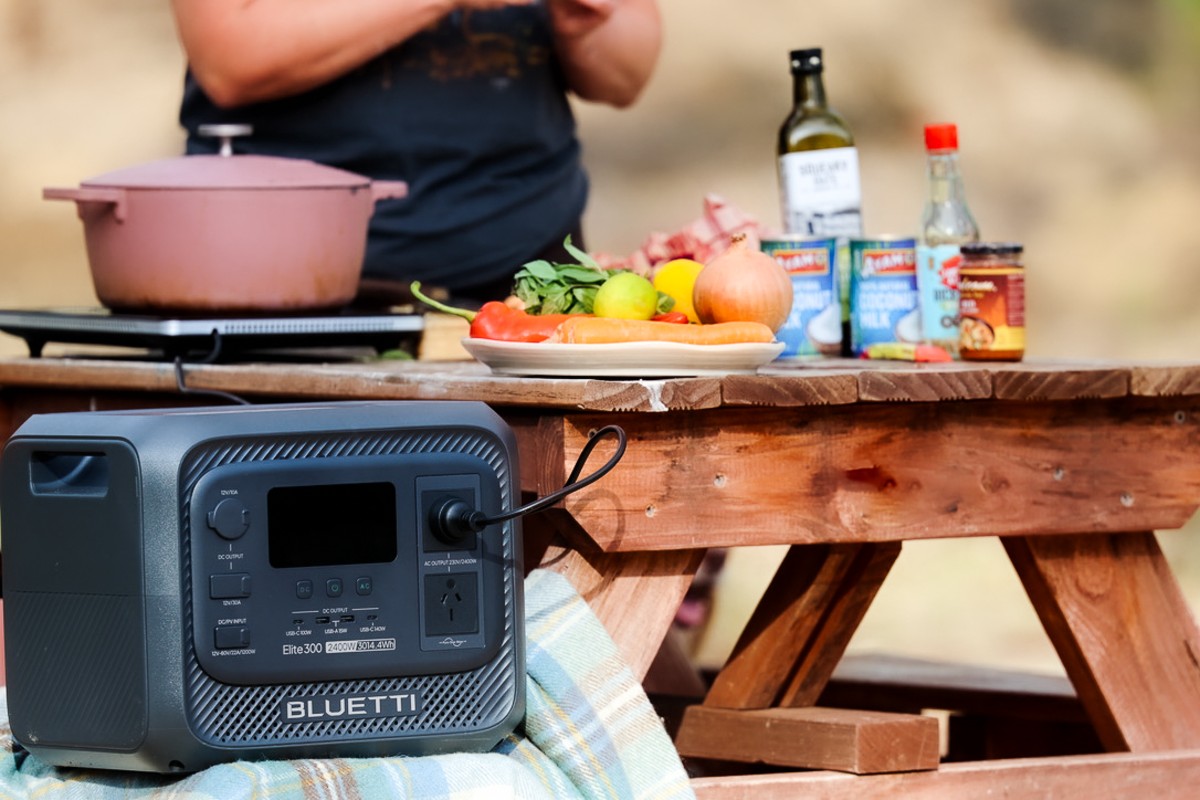
- The BLUETTI Elite 300 packs 3,014.4Wh into about 26.3kg. It has a 2,400W output and a 4,800W surge rating, which may also support additional devices if their combined continuous loads and startup demands remain within the station's limits and the available battery energy meets the required runtime. Consider Wi-Fi and lights. A 10ms UPS switchover is listed. However, check fridge startup compatibility.


BLUETTI Elite 300 Portable Power Station 3,014Wh, 2,400W
1,200W Max Solar Input
≤10ms UPS Response Time
6,000+ Life Cycles to 80% Capacity
3kWh Power at 2kWh Portability (Just 26.3kg)
8 Versatile Ports for Plug-and-Play Convenience
XT90 12V/30 A RV Port — Ideal for Van Life & DIY Setups
| Fridge label | Elite 100 V2 | Elite 200 V2 | Elite 300 |
| 318 kWh/yr | About 23 hours | About 46 hours | About 66 hours |
| 458 kWh/yr | About 16 hours | About 32 hours | About 46 hours |
| 542 kWh/yr | About 13 hours | About 27 hours | About 39 hours |
The actual runtime will vary depending on device wattage, temperature, usage pattern, battery condition, and efficiency loss. Use these numbers as approximate figures only.
Portable Power Station or Home Battery Backup
A fridge can be kept cold with either option. They are appropriate for various circumstances. A portable unit is a plug-in tool, and a home battery is a fixed system.

RACV clarifies the reason grid-connected solar shuts down during a blackout. Without a backup function, a home battery won't back up your home. A portable power station is not a whole-home backup.
| Scenario | Portable power station | Home battery backup |
| Short outage | Connect a refrigerator and some devices | Works if backup-enabled |
| Overnight | Suits an efficient fridge | Works, but check backup circuits |
| Multi-day | Requires solar or additional charging | Better with solar charging |
| Multiple critical loads | Restricted by outlets and watts | Hardwired circuits sized by an installer |
Recharge Options and Solar Support
You can recharge these units from wall power, a car, or solar. The Elite 100 V2 is capable of hitting 80% in 45 minutes on wall power. The Elite 200 V2 requires 1.1 hours, and the Elite 300 requires approximately 1.3 hours. For standalone power station packages, both V2 models require a separately purchased 20A MC4-XT60 solar cable. For bundles, check the included accessories in the relevant IN THE BOX list.
How Much Solar You Might Get
The Bureau of Meteorology records solar exposure between 1 and 35 MJ/m² per day. Southern coasts get less than northern coasts. For instance, 20 MJ/m² is approximately 5.6 peak sun hours, which is equivalent to hours of full-strength sunlight.
On a sunny summer day, a 200W panel could produce approximately 780Wh. This is assuming a 0.7 derate, which means that the actual output is 70% of the rated output. It is an approximation and not a guarantee. A 458 kWh/yr fridge may need 2 of these panels, and more in winter.
Panels can still generate power during a blackout if it is daytime. This hazard is identified by Energy Safe Victoria. Check out solar panels or a solar generator kit to compare.
Ways to Stretch Your Fridge Runtime
Little things conserve a lot of energy! Each saved Wh adds minutes.
- Only open the door when necessary.
- If the battery runs low, move food into the freezer, as Safe Food Victoria suggests for outages without power.
- Use only the fridge and a few essentials in the unit.
- Avoid placing the fridge or power station near an oven or sunny windows.
- Locate the power station in a shaded and ventilated area.

A Quick Note on Food Safety
This is not a guide to food timing. Different times are provided by Australian sources. The Food Safety Information Council, NSW and Victoria, do not all agree.
Keep doors shut and note the outage time. Keep-or-discard advice is included in our food safety guide.
Frequently Asked Questions
Yes, often, if the output and startup handling are appropriate for your fridge. Read both manuals first. Use the power station's approved AC outlet and connection method. Never connect it to household wiring or a wall socket to supply the home without professionally installed, approved transfer equipment.

Shop Products for This Article


You May Also Like